How to count a cribbage hand step by step
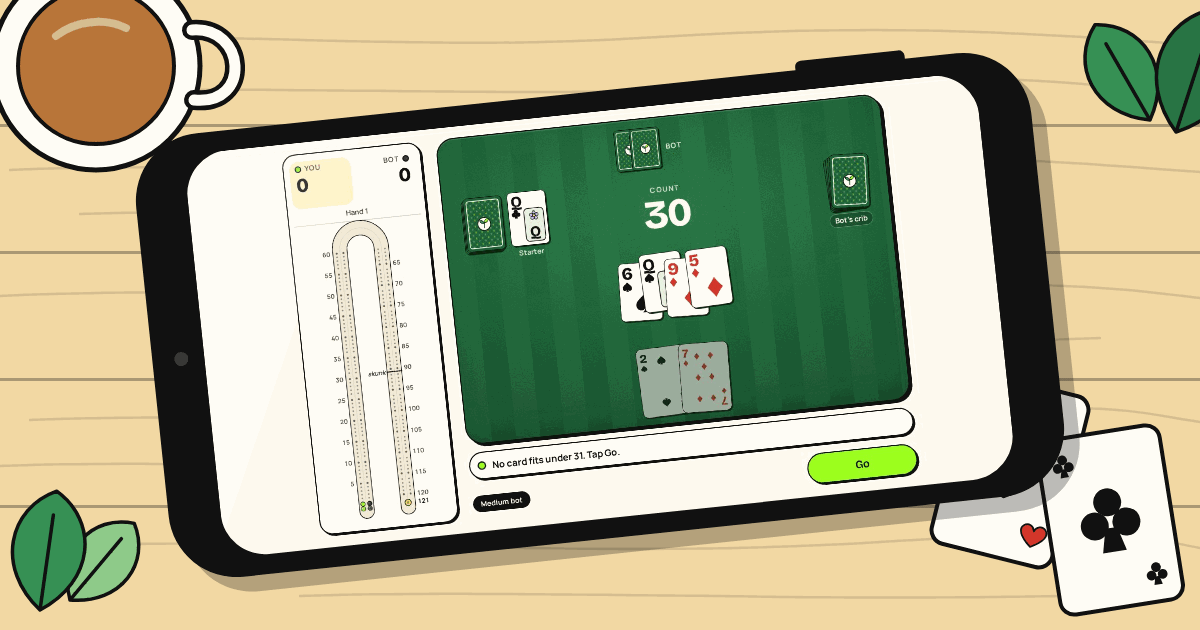
To count a cribbage hand step by step, tally your points in a strict order by finding fifteens, pairs, runs, flushes, and finally the right jack. You combine your four held cards with the shared starter card to score your total.
Cribbage is a classic card game that rewards careful observation. Scoring your hand correctly is just as important as playing your cards well. New players often struggle to spot every hidden combination. If you miss points, your opponent might be able to claim them. This guide will walk you through the exact sequence used by experienced players. You will learn how to break down your cards logically, ensuring you never leave hard-earned points on the table.
Contents
- The standard order of scoring
- Step one: finding every fifteen
- Step two: spotting pairs and multiples
- Step three: building consecutive runs
- Step four: checking for a flush
- Step five: remembering his nobs
- Complex combinations and double runs
- Using the GamesGarden hand calculator
- Playing against the friendly bot
The standard order of scoring
A standard game of cribbage is played to exactly 121 points on a traditional wooden pegboard. To reach that goal, you need to extract maximum value from every round. Once the pegging phase finishes, players reveal their hands. The non-dealer counts first, followed by the dealer. The dealer then counts the crib.
To count accurately, you must always look at all five available cards. These are the four cards in your hand plus the single cut card resting on the deck. Players use a specific mnemonic order to avoid missing anything.
Experienced players check their cards in this exact sequence:
- Fifteens (combinations adding up to fifteen)
- Pairs (two or more cards of the same rank)
- Runs (sequences of three or more consecutive cards)
- Flushes (four or five cards of the same suit)
- His nobs (holding the jack of the same suit as the starter card)
Sticking to this order prevents confusion. When you jump around, you are much more likely to count the same combination twice or miss a subtle pairing completely.
Step one: finding every fifteen
The core mechanic of the game revolves around the number fifteen. You score exactly 2 points for every distinct combination of cards that adds up to 15. All face cards are worth ten points. Aces are worth one point. Every other card is worth its numerical face value.
You can use as many cards as you like to reach this magic number. A king and a five make fifteen. An eight and a seven make fifteen. You can also use three, four, or even all five cards. For example, a hand containing a two, a three, a four, and a six adds up to exactly fifteen. That combination is worth two points.
The trick is to find every separate grouping. If you hold an eight, a seven, and another seven, you have two different ways to make fifteen. The eight combines with the first seven for two points. The same eight combines with the second seven for another two points. Always count your fifteens out loud, saying "fifteen two, fifteen four" to keep track.
Step two: spotting pairs and multiples
After you have exhausted all your fifteens, you move on to pairs. Any two cards of the exact same rank score two points. Suit does not matter for this step. If you hold two queens, that is two points. If you hold two fours, that is two points.
Things get interesting when you hold more than two cards of the same rank. A pair royal is the traditional name for three of a kind, and it awards you exactly 6 points. This is because three cards actually contain three distinct pairs. Card A matches Card B, Card A matches Card C, and Card B matches Card C.
A double pair royal consists of four identical ranks and gives you 12 points. Four of a kind contains six separate pairs. Finding a double pair royal is rare but highly rewarding. Just remember to add these points to whatever you already scored in the fifteen step.
Step three: building consecutive runs
The next step is to look for consecutive sequences, known as runs. A run must consist of at least three cards in sequential order. Aces are always low. Suits do not matter when forming a run. A run of three cards scores three points. A run of four cards scores four points. A run of all five cards scores five points.
You only score the longest possible run for any given set of cards. If you have a run of four, you score four points total. You do not also score for the smaller runs of three contained within it.
Runs are often the most difficult part of the hand to spot. They can hide behind duplicate cards or face cards. Always lay your cards out in numerical order on the table before you begin counting. This simple visual trick makes spotting sequences much easier.
Step four: checking for a flush
Flushes operate under very specific rules depending on whether you are counting your main hand or the crib. To score a flush in your main hand, all four cards you hold must be of the exact same suit. If they are, you score four points. If the starter card on the deck also matches that suit, your flush extends to five cards, scoring five points.
The rules change slightly for the dealer's crib. A four-card flush in the crib scores absolutely nothing. For the crib to score a flush, all four cards plus the starter card must be the exact same suit. This five-card flush will score five points.
Remember that flushes are the only scoring category where suits matter. Never try to mix suits when claiming a flush, and always check the starter card to see if you get that bonus fifth point.
Step five: remembering his nobs
The final step in counting is a simple one point bonus. If you hold a jack in your hand, and that jack matches the suit of the starter card, you score one point. This specific point is traditionally called "his nobs".
This is different from "his heels". His heels occurs during the cutting phase before the cards are played. If the dealer cuts a jack as the starter card, the dealer immediately scores two points. His nobs is scored at the very end of the hand during the counting phase.
Always announce "and one for his nobs" at the end of your count. It is a small bonus, but in a tight game, a single point can easily determine the winner.
Complex combinations and double runs
The most confusing hands usually involve multiple combinations overlapping. The most famous example is the double run. A double run occurs when you have a sequence of three cards, and you also hold a duplicate of one of those cards. For example, you hold a seven, an eight, another eight, and a nine.
To count this correctly, you must break it down. You have a run of three (7, 8, 9) using the first eight. That is three points. You have a second run of three (7, 8, 9) using the second eight. That is another three points. Finally, you have a pair of eights. That is two points. In total, a basic double run of three is always worth eight points.
A double-double run happens when you have two pairs mixed into a run of three. For example, two sevens, two eights, and a nine. This hand creates four distinct runs of three, plus two separate pairs, totalling sixteen points before you even look for fifteens.
The highest possible score in a single cribbage hand is exactly 29 points. To achieve this, you need a five as the starter card. In your hand, you must hold the other three fives, plus the jack that matches the suit of the starter card. This creates massive overlapping combinations of fifteens, a double pair royal, and his nobs.
Using the GamesGarden hand calculator
Even with practice, complex hands can be tricky to add up quickly. If you want to check your maths, you can use our free tool. The GamesGarden calculator is designed to help you verify your scores instantly without any guesswork.
To use the tool effectively, follow these simple steps:
- Select the four cards that make up your hand by clicking their ranks and suits.
- Select the single starter card that was cut from the deck.
- Indicate whether you are scoring your main hand or the crib.
- The score appears as soon as the fifth card is in, broken down by category.
The tool will display exactly how many points you earned from fifteens, pairs, runs, flushes, and nobs. It is an excellent way to learn the game. By testing different card combinations, you will quickly train your brain to spot hidden patterns.
Playing against the friendly bot
The best way to improve your counting speed is to play regular matches. You can play classic cribbage directly in your browser at GamesGarden. There is no sign-up required, and you can play on your phone or laptop whenever you have a spare moment.
The game features a friendly bot opponent with four distinct difficulty levels. This allows you to practice at your own pace. Beginners can start on the easiest level to get comfortable with the counting rhythm. Advanced players can challenge the highest level for a serious test of skill.
As you play, the automated scoring will show you exactly what points you earned. This immediate feedback loop is the fastest way to master the counting order.
If you need a refresher on the basic rules, the pegging phase, or the board layout, you can always read our comprehensive guide. It explains everything you need to know to move from a beginner to a confident player.