Gin rummy knock rules: when to knock and undercuts
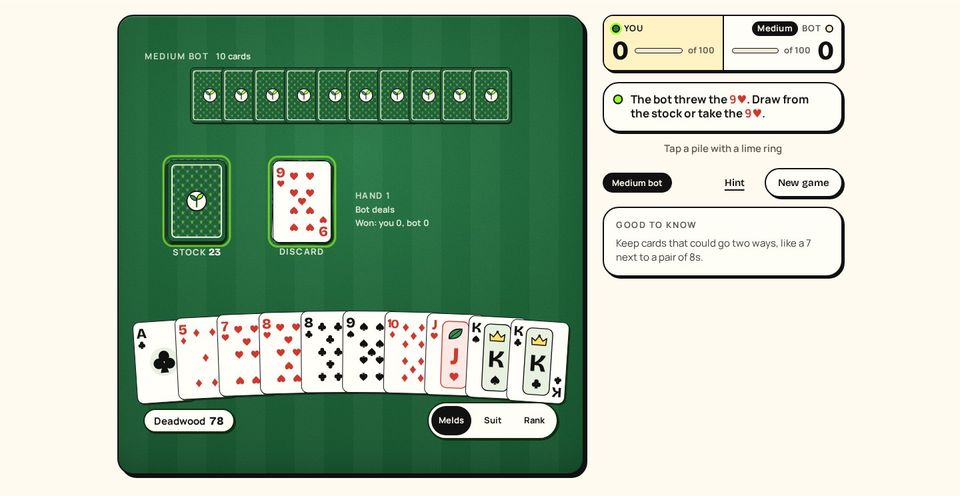
In gin rummy, you can knock when your unmatched cards total 10 points or fewer, but you risk an undercut if your opponent's deadwood score equals or beats yours. Going gin avoids this risk entirely by leaving you with zero deadwood.
Knowing exactly when to end a hand is the most important skill in gin rummy. It is a game of calculated risk, balancing the speed of an early finish against the danger of a heavy penalty. If you wait too long to build a perfect hand, your opponent might catch you with a fistful of unmatched face cards. If you rush to finish the round with a weak hand, you might hand your opponent a massive bonus on a silver platter.
Understanding the exact mechanics of knocking, laying off cards, and scoring undercuts will completely change how you approach the game. Whether you are learning the ropes or looking to beat a friendly bot at higher levels, mastering these mechanics is essential. In this guide, we will break down the deadwood limit, compare knocking directly to going gin, and provide detailed worked examples to help you plan your next move.
Contents
- What does it mean to knock in gin rummy?
- The rules of forming melds and deadwood
- Knocking vs going gin: a direct comparison
- The undercut: rules and how ties work
- How laying off cards changes the score
- Worked examples of gin rummy knocks
- Strategic rules for when to knock early
- The risks of waiting for a perfect gin
- Tools to practice your deadwood count
What does it mean to knock in gin rummy?
In standard gin rummy, knocking is the action that ends the current hand. A standard deck of cards contains 52 cards, and you are dealt 10 cards to begin the hand. On your turn, you draw a card to give yourself 11 cards, and then you must discard one to return your hand to 10 cards. If, after discarding, the total point value of your unmatched cards is 10 or less, you are allowed to knock.
You do not have to knock just because you can. You might choose to keep playing in hopes of improving your hand further, but knocking allows you to stop the play before your opponent can finish their own hand. When you knock, you lay your melds and your unmatched cards face up on the table. Your opponent must then do the same.
The cards that do not fit into any valid combination are called deadwood. To knock legally, your unmatched cards must total 10 points or fewer. If your deadwood totals 11 points or more, you must continue playing. This simple threshold creates the core tension of the game, forcing players to constantly evaluate whether they should race to the finish line or build a stronger hand.
The rules of forming melds and deadwood
To understand the deadwood limit, you first need to understand how to form valid combinations, known as melds. In standard traditional rules, there are only two types of valid melds you can form with a standard French deck of playing cards.
- Sets: Three or four cards of the exact same rank, such as three sevens or four kings.
- Runs: Three or more consecutive cards of the exact same suit, such as the four, five, and six of hearts.
A single card cannot belong to two different melds at the same time. If you have a set of three eights and a run of six, seven, and eight of clubs, you must choose where the eight of clubs belongs. It cannot do double duty.
Any card in your hand that is not part of a set or a run is considered deadwood. The point values for deadwood are strictly defined. A king, queen, or jack will each cost you 10 points in deadwood. Number cards are worth their face value, so a seven is worth seven points. An ace is worth exactly 1 point, making it a very valuable card to hold as deadwood when you are trying to sneak under the 10-point limit.
Knocking vs going gin: a direct comparison
Players often wonder whether they should knock as soon as their deadwood drops to 10, or if they should wait until they have exactly zero deadwood. Having zero deadwood is known as going gin. The two approaches carry very different risks and rewards.
| Feature | Knocking (1 to 10 deadwood) | Going Gin (0 deadwood) |
|---|---|---|
| Speed | Usually much faster to achieve. | Takes longer, giving the opponent time. |
| Opponent Layoffs | Opponent can lay off cards on your melds. | Opponent cannot lay off cards at all. |
| Undercut Risk | High risk if your deadwood is close to 10. | No risk; it is mathematically impossible to be undercut. |
| Point Bonuses | No bonus points; you only score the deadwood difference. | You receive a 25-point bonus plus the opponent's total deadwood. |
As the table shows, going gin is incredibly powerful. Going gin rewards the player with a 25-point bonus, completely avoiding any risk of an undercut. Because your opponent is not allowed to lay off any of their unmatched cards onto your melds when you go gin, they are often caught with a very high deadwood score, padding your total significantly.
However, knocking early is a defensive strategy. By ending the round quickly, you deny your opponent the time they need to complete their own melds. A quick knock might only earn you a few points, but it prevents the disaster of letting your opponent go gin. Learning when to choose speed over points is what separates a beginner from a veteran.
The undercut: rules and how ties work
The undercut is the most punishing mechanic in the game, and it is the main reason players hesitate to knock with high deadwood. When you knock, you compare your deadwood score to your opponent's final deadwood score. You want your score to be lower than theirs.
If your opponent's final deadwood score is lower than your knocking score, they have undercut you. If your opponent undercuts you, they receive a 25-point bonus plus the difference in deadwood. For example, if you knock with 8 points and they finish with 5 points, they score a 28-point victory for that hand.
Ties are also resolved in favour of the defending player. If you knock with 6 points of deadwood, and your opponent also finishes with 6 points of deadwood, they have successfully undercut you. The non-knocker always wins ties in standard play. They will receive the 25-point bonus, though there is no deadwood difference to add to it. This strict rule means you must be very confident before you knock, especially if the deck is running low and your opponent has had many turns to improve their hand.
How laying off cards changes the score
The crucial step between a player knocking and the final score being calculated is the layoff phase. When you knock, you place your melds on the table. Your opponent then reveals their hand. Before the final deadwood is tallied, the defending opponent has the right to lay off their unmatched cards onto your valid melds.
For instance, if you have a meld consisting of the seven, eight, and nine of spades, and your opponent is holding the ten of spades as deadwood, they can lay their ten onto your run. That card is no longer deadwood for them. If you have a set of three kings, and they hold the fourth king, they can lay it off onto your set.
It is very important to note that the knocker is never allowed to lay off cards onto the opponent's melds. The layoff privilege belongs exclusively to the defender. This mechanic is what makes undercuts so common. A defender might start with 15 points of deadwood, but by laying off a heavy face card onto the knocker's melds, they can drop their score down to 5 points and steal the victory.
Worked examples of gin rummy knocks
To make these abstract rules clearer, let us walk through a few concrete scenarios you might encounter while playing gin rummy. Reading a complete guide is helpful, but seeing the maths in action is the best way to grasp the strategy.
Example A: The safe early knock
You are on turn four. You have two solid melds and your deadwood consists of a two and a three, giving you 5 points of deadwood. You decide to knock. Your opponent reveals their hand. They were building a large hand and got caught early. They have one meld and 35 points of deadwood. They look at your melds but cannot lay off any cards. You win the hand, scoring 30 points (the 35 points they had, minus your 5 points).
Example B: The disastrous undercut
It is late in the game. You finally draw a card that drops your deadwood to 9 points, and you decide to knock to avoid letting your opponent go gin. You lay down your melds. Your deadwood is a nine. Your opponent reveals their hand. They have 12 points of deadwood, consisting of a queen and a two. However, your melds include a set of three queens. Your opponent lays off their queen onto your set. Their deadwood drops from 12 to exactly 2. Because 2 is lower than your 9, they have undercut you. They score 7 points for the difference, plus the 25-point undercut bonus, for a total of 32 points.
Example C: Going gin
You draw the exact card you need to complete your final run. You have zero deadwood. You declare gin and lay down your hand. Your opponent has 18 points of deadwood. Even though your opponent holds a card that would normally lay off onto one of your runs, they are not allowed to play it because you went gin. You score their full 18 points of deadwood, plus the 25-point gin bonus, earning a massive 43 points for the hand.
Strategic rules for when to knock early
Knowing the mechanics is only half the battle. Deciding when to pull the trigger is a matter of strategy. If you play against a bot at four levels on GamesGarden, you will notice that the higher difficulty bots are ruthless about when they choose to knock. They do not wait around out of politeness.
- Knock as early as possible: If you can knock within the first few turns of a hand, do it. Early in the game, your opponent is very likely to be holding unmelded face cards, meaning their deadwood count will be massive.
- Watch the discard pile: Pay close attention to what your opponent is picking up from the discard pile. If they have picked up two cards of the same suit, they are building a run. You can use this knowledge to ensure you do not knock while holding cards they can easily lay off.
- Discard high cards quickly: Holding onto high pairs in the hopes of drawing a third is dangerous. A king, queen, or jack will cost you 10 points in deadwood. If the opponent knocks early, those high cards will destroy your score. Keep low cards like aces and twos as your deadwood instead.
- Adjust to the deck size: As the stockpile shrinks, the risk of an undercut grows. If there are only a few cards left to draw, your opponent has had plenty of time to refine their hand. Knocking with 9 or 10 points late in the game is incredibly risky.
The risks of waiting for a perfect gin
It is always tempting to chase a perfect hand. The 25-point bonus is alluring, and the feeling of laying down a flawless hand is brilliant. However, veteran players know that waiting for gin is often a mathematical mistake, especially if your deadwood is already quite low.
- Giving the opponent time: Every turn you spend waiting for that one specific card is another turn your opponent gets to draw. You are giving them free opportunities to complete their own melds or to beat you to the knock.
- The dead-end draw: The card you need to complete your gin might be buried at the very bottom of the stockpile, or worse, it might be sitting in your opponent's hand as deadwood they are refusing to discard. If you stubbornly wait for a card that will never come, you will eventually lose the hand.
- Lost points: If you have 3 points of deadwood and choose not to knock, you might eventually go gin. But if you had knocked immediately, you might have caught the opponent with 40 points of deadwood. By waiting, they might whittle their deadwood down to 10, drastically reducing your final score even when you do get the gin bonus.
Much like deciding how to evaluate a hand in cribbage, gin rummy requires you to play the odds. You must weigh the guaranteed safety of a low-deadwood knock against the speculative dream of a perfect gin.
Tools to practice your deadwood count
The maths in gin rummy can take some getting used to, especially when calculating complex layoffs in your head. Knowing exactly which cards will leave you with the lowest deadwood score is a skill that comes with practice.
If you are ever unsure about the best way to arrange your hand, or if you want to double-check your deadwood total before making a risky move, you can use a free tool to do the heavy lifting. Our helper tool allows you to input your exact hand and instantly see the most efficient way to group your cards into sets and runs, minimising your deadwood score automatically.
The best way to improve your timing is simply to play. GamesGarden offers classic games you can play instantly on your phone or laptop with no download and no sign-up. You can test your knocking strategies against a friendly bot at four levels of difficulty, ensuring you get the perfect challenge whether you are a beginner or an expert. So keep your deadwood low, watch out for undercuts, and enjoy the game.