The 4% rule explained and how to test it in a free game
The 4% rule is a retirement guideline suggesting you can withdraw four percent of your investment portfolio in your first year of retirement, adjusting for inflation annually, without running out of money over thirty years.
Understanding how long your savings will last is one of the biggest challenges in personal finance. For decades, people wondered how much they could safely spend from their nest egg without facing an empty bank account in their later years. The rule of four percent emerged as a mathematical answer to this very human worry. It gives a starting point for planning a future where you rely on your own investments rather than a regular salary. While it is important to remember that this article is for educational purposes and does not constitute financial advice, exploring these concepts can make you much more confident about how financial markets work.
You do not need to risk real money to understand how market crashes and inflation affect a long-term plan. GamesGarden offers a perfect way to experience these financial forces in a safe environment. You can play a money life simulator that lets you live a working life from 22 to 62, pay the bills, invest and ride out crashes. Before we look at how to test your skills in the game, let us explore exactly what this famous retirement rule is and where it comes from.
Contents
- What is the 4% rule?
- Where does the 4% rule come from?
- The core mechanics of safe withdrawal
- The limits and risks of the rule
- Understanding sequence of returns risk
- Test your strategy in Make me Rich
- Why browser games help build money skills
- Conclusion
What is the 4% rule?
The rule is a practical method for determining a safe withdrawal rate from a retirement portfolio. It states that if you withdraw four percent of your total invested savings during your first year of retirement, you establish a baseline income. In every following year, you do not recalculate four percent of your remaining balance. Instead, you take that initial cash amount and increase it by the rate of inflation.
For example, if a person retires with a portfolio of one million pounds, their first withdrawal would be forty thousand pounds. If inflation runs at exactly two percent that year, their withdrawal for the second year would increase to forty thousand and eight hundred pounds. This adjustment ensures that the retiree maintains their purchasing power, regardless of what the stock market does in that specific year.
This steady withdrawal approach provides predictability. It allows someone to plan their budget around a known income stream rather than constantly worrying about daily stock prices. However, the rule relies on the assumption that the underlying investments will generate enough growth over the long term to replenish the withdrawn funds and keep pace with inflation.
Where does the 4% rule come from?
The foundation of this guideline rests on a famous piece of financial research known as the Trinity study. Published in 1998 by three finance professors at Trinity University in Texas, the study sought to find a withdrawal rate that would survive even the worst economic periods in history.
The researchers looked at historical data for the Standard and Poor's 500 Index and long-term United States corporate bonds. They tested various withdrawal rates over overlapping retirement periods of 15 to 30 years, using real market data from 1926 to 1995. This meant their tests included the Great Depression, the high inflation of the 1970s and multiple severe market crashes.
They found that a portfolio split evenly between stocks and bonds could sustain a four percent inflation-adjusted withdrawal for a 30-year retirement period without running out of money in almost every historical scenario they tested. It was a revelation for financial planning, turning guesswork into a strategy backed by decades of data.
The Trinity study relied on several key assumptions to reach its conclusions. Understanding these assumptions is critical for anyone studying market history:
- A specific time horizon of exactly 30 years in retirement.
- A diversified portfolio divided between large company stocks and high quality bonds.
- Strict adherence to adjusting the initial withdrawal amount only for inflation, ignoring market performance.
- Historical market returns remaining a reliable guide for future market behaviour.
The core mechanics of safe withdrawal
To grasp why the guideline works mathematically, you have to understand the relationship between asset growth and inflation. Over long periods, stock markets have historically grown at a rate faster than inflation. This "real return" is the engine that powers a long-term portfolio.
When you withdraw four percent, you are essentially betting that your investments will grow by at least that much, plus whatever inflation happens to be, on average over three decades. Some years the market will drop twenty percent. Other years it might rise thirty percent. The rule depends on the long-term average smoothing out these wild short-term swings.
The bond portion of the portfolio acts as a shock absorber. When stock prices fall dramatically, bonds typically hold their value or even increase in price. This means the retiree can sell bonds to fund their living expenses during a stock market crash, giving their shares time to recover. This rebalancing act is central to the success of any withdrawal strategy.
The limits and risks of the rule
While the Trinity study is a cornerstone of financial education, modern economists frequently point out the limits of the four percent guideline. The world has changed significantly since 1998, and blind faith in a single number can be dangerous.
One major limit is the assumption of a 30-year retirement. As life expectancy increases, many people are spending 40 or even 50 years in retirement. A withdrawal rate that survives three decades might fail over four decades, simply because the money has to stretch further and survive more market crashes.
Another limit is the impact of investment fees and taxes. The original study used raw market indices, which do not charge management fees. In the real world, investors pay platform fees, fund management fees and trading costs. These expenses drag down the overall return, meaning the true safe withdrawal rate for a fee-paying investor might be closer to three or three and a half percent.
Experts point to several factors that can break the historical safety of the rule:
- Extended periods of very high inflation, which force the withdrawal amount to climb rapidly.
- Retiring exactly at the peak of a major market bubble, followed by a decade of stagnation.
- Paying high ongoing fees to financial advisers or investment platforms.
- Failing to stick to the strategy and panic-selling during a severe market crash.
Understanding sequence of returns risk
The biggest threat to a retirement portfolio is something called sequence of returns risk. This is a complex term for a simple concept. It means that the order in which you experience investment returns matters just as much as the average return itself.
Imagine two investors who both average a five percent return over thirty years. The first investor experiences a huge market crash in their very first year of retirement, while the second investor experiences a huge crash in their twentieth year of retirement. The first investor is in serious trouble.
Because the first investor is withdrawing money while the portfolio is deeply depleted from the crash, they have to sell a larger percentage of their shares just to meet their living expenses. When the market eventually recovers, they have fewer shares left to capture the growth. This mathematical trap can drain a portfolio entirely, even if the long-term average return looks acceptable on paper.
This is why financial education often focuses heavily on the first five to ten years of retirement. If you can survive the early years without a major loss, the magic of compounding interest usually secures your financial future. If you face a severe crash early on, you may need to reduce your spending temporarily to protect your capital.
Test your strategy in Make me Rich
Reading about sequence of returns risk and market crashes is one thing, but experiencing the pressure of managing a portfolio is another. You can test your nerve and your understanding of these concepts in a free browser game provided by GamesGarden.
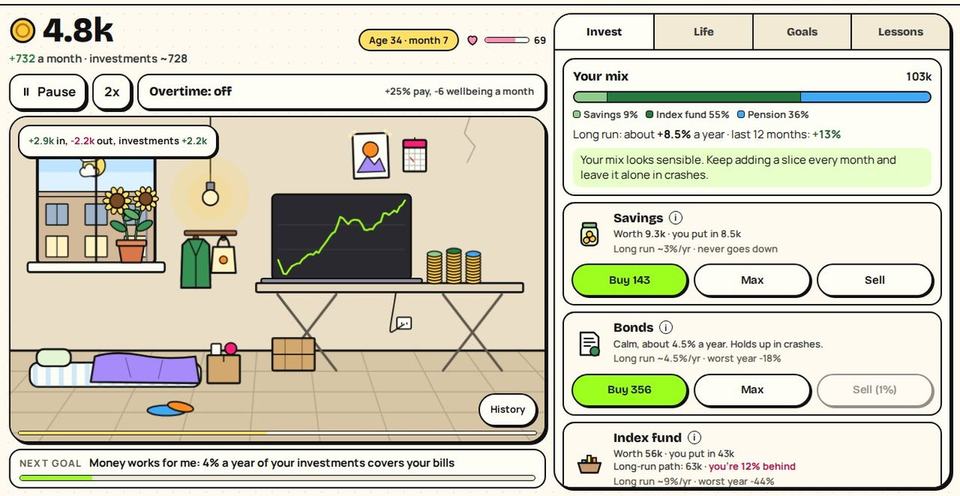
The game is called Make me Rich, and it is a money life simulator. The game challenges you to live a working life from 22 to 62. Throughout the simulation, you must pay the bills, invest your remaining cash and ride out terrifying market crashes.
As you progress through your simulated working life, you have to decide how to allocate your funds. You will watch your portfolio grow during boom years, and you will feel the stress of watching it plummet when the market turns against you. It is a fantastic way to understand how long-term investing actually feels. If you need help getting started, you can read the complete guide to master the mechanics.
One of the most interesting features of Make me Rich is the weekly market where everyone plays the same 15 years. This allows you to compare your decisions against other players who faced the exact same economic conditions. Did you panic and sell at the bottom, or did you hold your nerve and ride out the crash? Comparing your results with others provides a brilliant lesson in market psychology.
This game is completely free, runs directly in your browser on a phone or laptop, and requires no download and no sign-up. Ads never interrupt play, so you can focus entirely on building your virtual wealth and testing your financial theories.
Why browser games help build money skills
There is a growing movement towards using interactive experiences to teach complex subjects. When it comes to personal finance, traditional textbooks often fail to convey the emotional weight of losing money. A simulator bridges this gap by making the abstract numbers feel real.
Games like Make me Rich fall perfectly into the category of Educational games that teach real money skills. They allow you to make catastrophic mistakes without losing a single penny of your real savings. You can experiment with different risk levels, try aggressive growth strategies, or play it completely safe and see how inflation slowly eats away at your purchasing power.
Because GamesGarden builds these experiences to be accessible anywhere, they fit perfectly into a busy day. You can play a few simulated years while waiting for a bus or during a lunch break. If you are looking for more ways to challenge your brain without jumping through hoops, you can explore other options in our list of 10 free browser games with no sign-up for your phone.
The beauty of this format is that anyone can plant a game idea. Real people and AI build each one with its author over rounds of play, and early versions go into an open playtest where anyone can play and vote. The author's garden name goes on the game, and authors can share in what their game earns, under a separate written agreement. It is a community driven approach to creating thoughtful, engaging puzzles and simulators.
When you play a money simulator, you start to view news about the economy differently. You understand why interest rates matter, why inflation is a threat, and why diversification is a shield against disaster. You learn to ignore the daily noise of the stock market and focus on the decades long horizon.
Conclusion
The 4% rule remains one of the most discussed concepts in personal finance. Born from the Trinity study, it provides a fascinating mathematical framework for surviving a 30-year retirement. While it has its limits and is definitely not formal advice, understanding how it protects against inflation and market crashes is an essential part of financial education.
The best way to truly grasp these concepts is to put them into practice. By trying out a money life simulator, you can experience the highs and lows of long-term investing without any real-world risk. We encourage you to head over to GamesGarden, load up Make me Rich, and see if you have the nerve to ride out the crashes and build a secure future. Your virtual retirement awaits.