Game guide
Planted by LostVoiceMake me Rich guide: how to play, rules and tips
Make me Rich is a free money game you play in your browser on GamesGarden, on phone or laptop. You live a working life from 22 to 62: your job pays, bills go out, prices rise, and you choose your risks until your money can pay your life. The returns are shaped like the real thing, so crash years hurt and debt bites.
Play Make me Rich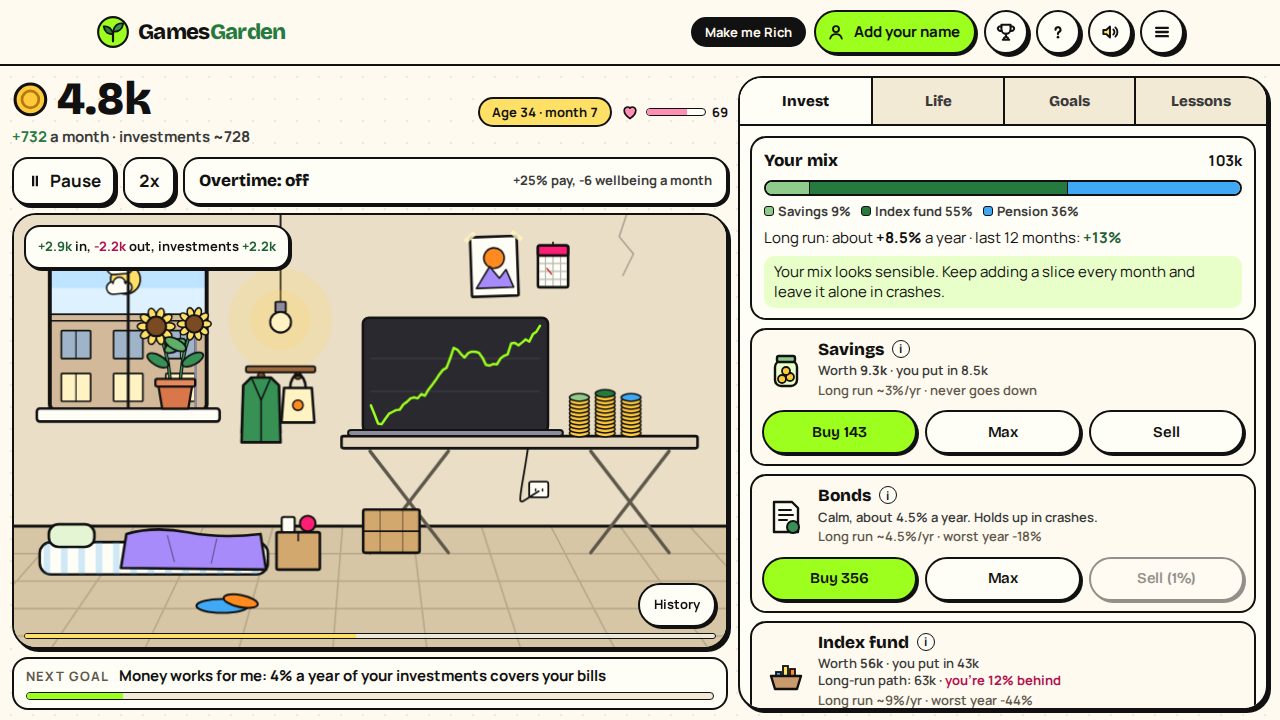
How to play
- Start a life at 22 with a job and 500 coins. Time runs on its own: pay comes in during the month, bills go out on payday.
- Open Invest and put spare money to work: savings, bonds, an index fund, and later single stocks, rental property and startup bets.
- Answer the cards as they come: a raise to ask for, a car on credit or used for cash, a friend who needs a loan, a hot tip. Every option has an upside and a cost, and you see why after you choose.
- Turn on Overtime for 25% more pay when you need it. It drains your wellbeing, and low wellbeing slows your raises and brings trouble.
- Every year ends with a review: what you earned, what your investments made, what interest cost you, and what a wise player would do next.
- When your investments can pay your bills, you may quit your job. Then keep the money working until 62.
Rules that matter
- Prices rise about 3% a year. Bills go up with them; your pay rises with prices plus a little for experience.
- Money out has an order: cash first, then savings, then investments are sold, then the credit card at 22% a year. You cannot buy investments while you owe on the card.
- Selling costs a fee: 1% for most investments, 3% for property, nothing for savings. Selling during a crash locks the loss in.
- Crashes come about once a decade and never twice within four years. The index fund can lose about a third over a few months, then recover over the next year or so.
- Startups are long shots. Each bet has its own fate: most close and pay nothing, a few return many times the money after a few years.
- Bankruptcy is a fresh start, not the end: too much card debt and everything is sold, you move to a shared room, your wellbeing drops and you cannot borrow for 5 years.
- Going back to work after quitting takes a few months of searching, and the new job pays less the longer you were away. The game shows both before you confirm.
What you learn
- Compounding: money left alone for decades grows into far more than you put in. Starting at 22 beats starting big at 40.
- Crash years: you live through them, watch your net worth fall, and find out whether you hold or sell. The history chart shows how it played out years later.
- Debt: card interest at 22% a year eats faster than almost any investment grows. Borrowing to invest can win big and lose big.
- The rainy-day fund: a few months of bills in savings turns a lost job or a surprise bill into a bump instead of new debt.
- The 4% rule: how much you need invested before your money can pay your life, and why the safe amount to take out is smaller than what markets earn on average.
- The Lessons tab keeps every lesson you meet, with a short plain explanation. This is a game with simplified numbers that teaches how money behaves, not advice on what to do with yours.
Tips and strategy
- Fill the rainy-day fund first. Three months of bills in savings before you take risks keeps you off the card.
- Clear card debt before anything else. Nothing you can buy reliably earns 22% a year.
- Spread your money. One company can sink while the index fund rides it out. Tap an investment to see how it behaves over 10, 20 and 30 years.
- Hold through a crash if you can. The players who sell in the dip usually end the life behind the ones who wait.
- Watch your home. A nicer home lifts wellbeing, but rent is the biggest bill most months, and moving costs money both ways.
- Read the Year Review. Its "what a wise player would do" line points at the cheapest fix: a missing fund, a costly loan, all eggs in one basket.
Modes
- A life (Endless): 22 to 62, about 40 to 60 minutes of active play spread over as many visits as you like. While you are away, up to 8 months pass on their own (one for every 15 minutes), with no cards. A life stays on your device.
- Weekly market: the same market and the same cards for everyone this week, 15 years from 22 to 37, about 20 minutes. Your net worth at 37 goes on the leaderboard: finish above zero for 1 garden point, up to 10 for a great run. Each points level counts once a week, so a run counts again when it reaches a higher level.
Controls
On a phone
- Tap the tabs (Invest, Life, Goals, Lessons) and the buttons. Tap an investment to see how it behaves, Buy to choose how much.
- Pause stops the clock while you look around; the speed button switches between a calm and a normal pace.
- Tap the laptop in your room, or History, for your whole life as a chart. Tap a marker to see what happened.
On a laptop
- Click everything you would tap.
- Space pauses and resumes the clock, Esc opens the menu. In History, zoom with the wheel or plus and minus, and drag to pan.
Questions and answers
Is Make me Rich free?
Yes. Make me Rich is free in your browser, with no download, no ads and nothing to buy.
Can I play Make me Rich on my phone?
Yes, it works on phones and laptops. Your life is saved on the device you play on.
Are the numbers real?
They are shaped by long-run market history: savings that never fall, an index fund that grows most over decades but can drop by a third in a crash, about 3% inflation a year, a credit card at 22% a year. They are simplified for a game. Make me Rich teaches how money behaves; it is not financial advice.
What is the 4% rule?
A rule of thumb from retirement research: if you take out about 4% of your investments a year, the money tends to last. In the game, when 4% a year of your investments covers your bills, you could quit your job and live off them.
What happens if I go broke?
When cash runs out, savings pay first, then investments are sold, then the credit card at 22% a year. Too much card debt means bankruptcy: everything is sold, you move to a shared room and cannot borrow for 5 years. It hurts, but the game goes on.
How does the leaderboard work?
The Weekly market goes on the leaderboard: everyone gets the same market and the same cards for one week, over 15 years. Your net worth at 37 is your score, and the server replays your whole run before it counts. A garden name is optional and needs no email.
Ready to play?
Make me Rich is free in your browser, with no download, no ads and no sign-up.
Play Make me Rich