Cribbage vs gin rummy: which card game should you learn?
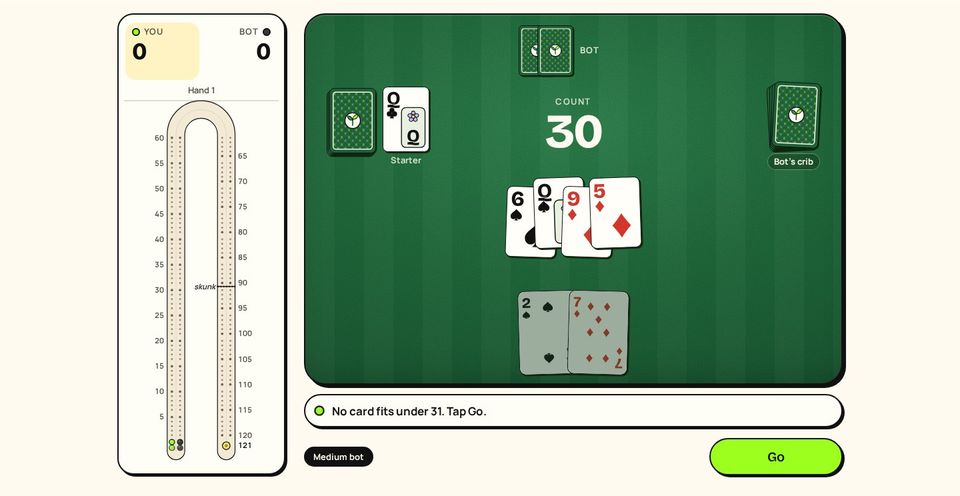
If you want a quick matching game focused on memory, learn gin rummy, but if you prefer a tactical race with varied scoring phases, cribbage is the better choice.
Card classics have entertained players for generations, and choosing the right one to learn can feel overwhelming. Many players find themselves stuck between these two popular options. They both use a standard 52-card deck containing no jokers, but they play very differently. One asks you to organise a hand secretly, while the other splits the action into playing cards out loud and counting combinations.
We will break down exactly how they work, the rules they follow, and the strategies they require. You can play both of these games for free in your browser right now. Whether you are on a phone or laptop, there is no download and no sign-up required, and ads never interrupt play.
Contents
- The appeal of classic card games
- The basics of gin rummy
- How gin rummy is scored
- The basics of cribbage
- How cribbage is scored
- Decision guide: how to choose
- Tools to help you learn
- Play against a friendly bot
The appeal of classic card games
Learning a traditional card game is a brilliant way to challenge your mind. These games have stood the test of time because they balance luck and skill perfectly. When you sit down to play, you are engaging in a battle of wits that requires focus, memory, and adaptability.
In today's busy world, a quick card match offers a welcome break. You do not need to learn complex video game controls or read a massive rulebook. The fundamental mechanics of drawing, discarding, and counting are intuitive. Once you grasp the basics, the depth of the strategy slowly reveals itself over many matches.
If you enjoy simple, accessible entertainment, you will find these titles perfect for short sessions. For more options that fit this style, you can explore our list of 10 free browser games with no sign-up for your phone. Both cribbage and gin rummy fit beautifully into a daily routine, offering endless replay value.
The basics of gin rummy
Gin rummy is a game of pattern recognition and careful hand management. In gin rummy, each player is dealt exactly 10 cards to begin the round. The rest of the deck is placed face down to form a stockpile, and the top card is turned over to start the discard pile.
Your primary goal is to organise your cards into melds. A meld is either a set or a run. A set consists of three or four cards of the exact same rank, such as three kings or four sevens. A run consists of three or more consecutive cards of the same suit, like the four, five, and six of hearts.
Any cards in your hand that are not part of a meld are called deadwood. You want to reduce your deadwood score as much as possible. On your turn, you must draw a card from either the face-down stockpile or the face-up discard pile. You then evaluate your hand and discard one card face up.
Drawing from the discard pile is tempting, but it gives your opponent valuable information. If they see you pick up a nine of clubs, they know you are building a run in clubs or a set of nines. Good players memorise the discards to predict what their opponent needs, making it a tense psychological duel.
How gin rummy is scored
The round ends when a player decides to knock. You can legally knock when the total value of your unmatched deadwood cards is 10 points or less. Face cards are worth 10 points, aces are worth 1 point, and all other cards are worth their face value.
When you knock, both players reveal their hands. The opposing player has a chance to lay off their own unmatched cards onto your melds, further reducing their deadwood. After this, you compare the deadwood scores. If your deadwood score is lower than your opponent's, you score the difference between the two totals.
However, knocking carries a risk. If your opponent ends up with an equal or lower deadwood score than yours, they have undercut you. They score the difference plus an undercut bonus. A standard game of gin rummy often targets 100 points to win a match.
If you manage to meld all 10 of your cards with no deadwood remaining, you go gin. Going gin awards a generous 25-point bonus on top of the opponent's deadwood score, and they are not allowed to lay off any cards. This makes going for gin a highly rewarding strategy.
The basics of cribbage
Cribbage is a game of two distinct halves, combining tactical play with mathematical combinations. In cribbage, players receive 6 cards and must discard 2 into the crib. The crib is a separate four-card hand that belongs to the dealer, and it is scored at the end of the round.
This initial discard creates a fantastic dilemma. If you are the dealer, you want to put good cards into your own crib. If you are not the dealer, you must try to discard safely, giving away as few points as possible. Once the discards are made, the non-dealer cuts the remaining deck, and a starter card is turned face up.
Next comes the pegging phase. Players take turns laying down one card at a time face up, keeping a running total of the values. Face cards in cribbage are all worth 10 points during the pegging phase, aces are worth 1 point, and others take their face value. The total cannot exceed 31.
You score points during the pegging phase by hitting exactly 15 or 31. You also score points by playing a card that makes a pair with the previous card, or by completing a run of three or more consecutive cards. Once the total reaches 31, or neither player can play without going over, the count resets to zero and pegging continues until all cards are played.
How cribbage is scored
After the pegging phase finishes, players move to the show. This is where you count the points in your hand. You use the four cards in your hand alongside the shared starter card to find combinations. The non-dealer counts their hand first, which is a crucial advantage near the end of a match.
Scoring combinations in cribbage are unique. You score 2 points for any combination of cards that adds up to exactly 15. You also score 2 points for a pair, 6 points for three of a kind, and 12 points for four of a kind. Runs of three or more cards score 1 point per card.
A cribbage match is traditionally played to 121 points on a wooden board. The board uses pegs to track the score, moving up and down the rows. When playing online, the computer handles moving the pegs for you, which makes it much easier to focus on the cards.
If you manage to win the game before your opponent has reached 91 points, you have skunked them. In competitive matches, a skunk counts as two wins. If you want a detailed breakdown of the counting rules, read our post on How to count a cribbage hand step by step.
Decision guide: how to choose
If you are staring at a deck of cards and wondering where to begin, this decision guide will help you settle the debate. We have broken down the experience into four main categories. Read through these points to see which style matches your preference.
- Players: Both of these games are strictly designed as two-player duels. You face off against a single opponent, making them highly focused and competitive.
- Time: Gin rummy rounds are very fast, taking just a few minutes, but a full match to 100 points can take 20 to 30 minutes. Cribbage usually takes about 15 to 25 minutes for a complete game to 121 points.
- Luck vs skill: Gin rummy relies heavily on the luck of the draw, but skill shines in reading the opponent's discards. Cribbage gives you more tactical control during the pegging phase, allowing a skilled player to trap a novice.
- Scoring: Gin rummy requires simple addition at the very end of a round. Cribbage requires constant, varied counting throughout the entire game, appealing to those who enjoy quick mental arithmetic.
If you enjoy keeping secrets, building a master plan quietly, and surprising your opponent at the end, gin rummy is your game. It feels like solving a private puzzle. You spend the whole round refining your hand until it is perfect.
If you prefer an active, back-and-forth battle where every single card played matters immediately, cribbage is the way to go. The pegging phase feels like a fencing match, with players parrying and striking for small points. The diverse scoring rules keep every hand interesting.
Tools to help you learn
Learning a new card game can feel intimidating at first, especially when you are trying to remember the scoring rules. Fortunately, GamesGarden provides excellent free tools to support your learning journey. You do not have to memorise everything on day one.
When you are learning cribbage, spotting every combination in your hand is tough. You might see the fifteens but miss a hidden run. We offer a dedicated cribbage hand calculator to help you. You can input your cards and the starter card, and it will break down exactly where your points come from.
If you are picking up gin rummy, understanding which cards to keep and which to discard takes practice. Managing your unmatched cards is the key to winning. You can use the gin rummy deadwood helper to calculate your score quickly and test different knocking scenarios.
To make your learning process smooth, try these general tips for both games:
- Start by playing slowly, ignoring the timer, and focusing purely on accurate counting.
- Read the dedicated guide for cribbage to grasp the pegging tactics.
- Consult the guide for gin rummy to learn the safest opening discards.
- Review your hand after every round to see what combinations you might have missed.
Play against a friendly bot
The absolute best way to learn either of these games is by playing them. Reading the rules is helpful, but the mechanics only truly click when you have cards in your virtual hand. GamesGarden lets you play against a friendly bot at 4 distinct levels of difficulty.
Starting on level one is highly recommended. The level one bot plays casually, giving you plenty of room to make mistakes while you learn the flow of the game. As your skills improve, you can advance to level two and level three, where the bot begins to use defensive tactics.
Level four offers a serious challenge for veteran players. At this level, the bot will track discards closely in gin rummy and employ ruthless pegging traps in cribbage. Playing against a bot means you can take as much time as you need to plan your moves without feeling rushed by a human opponent.
Both cribbage and gin rummy are available to play directly in your browser. There is no software to install and no account to create. The interface is clean and calm, ensuring that you can focus entirely on your strategy. Ads never interrupt play, preserving the relaxing atmosphere of a classic card session.
Anyone can plant a game idea at GamesGarden. If you have a fresh concept, early versions go into an open playtest where anyone can play and vote, and authors can share in what their game earns, under a separate written agreement, 18 or over or through a parent. But if you just want to relax with the classics, they are always waiting for you.
Ultimately, you do not have to choose just one. They both offer tremendous strategic depth and endless replayability. Head over to the site, load up a match, and try both against a bot today to see which one becomes your new favourite.