Can you jump backwards in checkers?
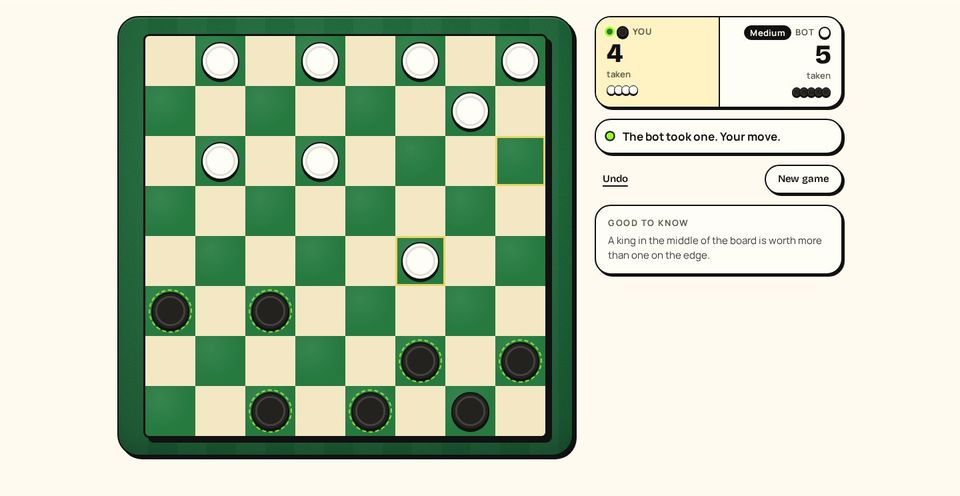
Whether you can jump backwards in checkers depends entirely on the version you play. In standard American checkers, ordinary pieces cannot jump backwards, but in international draughts, backward jumps are completely legal for all pieces.
Many players grow up learning a specific set of rules from their family. When you play against someone new, you might suddenly discover that their rules feel entirely different. The confusion about whether you can jump backwards in checkers usually comes down to geography. Different countries have adopted different official rules over the centuries. Understanding these rules can save you from a friendly argument at the board.
Contents
- Rule variations across the world
- A side-by-side comparison of checkers rules
- How kings change the game
- Forced jumps and game strategy
- House rules and playing with children
- Where to play checkers online
Rule variations across the world
The rules of checkers change depending on where you live. In the United States, the game is widely known as American checkers. This version is strict about forward movement. A normal piece, often called a man, can only move diagonally forward. It can also only capture diagonally forward. If an opponent leaves a piece vulnerable behind one of your men, you are out of luck. You simply cannot jump backwards in checkers when playing the American rules.
Across Europe and many other parts of the world, players favour international draughts. The World Draughts Federation oversees this globally recognised version of the game. In this format, normal pieces still only move forward into empty spaces. However, when it comes to capturing, the rules open up dramatically. If an opponent is diagonally behind your piece and the space behind them is empty, you can and must jump them. This makes the international game highly dynamic.
The physical boards for these two games are also entirely different. When you sit down to play, you will notice these specific changes:
- American checkers is played on an 8x8 board with 64 squares.
- Each player starts a standard American game with exactly 12 pieces.
- International draughts requires a larger 10x10 board with 100 squares.
- In the international version, each player begins the match with 20 pieces.
A side-by-side comparison of checkers rules
To make things perfectly clear, we can compare the two most common ways to play. This comparison highlights why so many people ask if you can jump backwards in checkers. The table below breaks down the main differences between standard American checkers and international draughts.
| Game Feature | American Checkers | International Draughts |
|---|---|---|
| Board size | 64 squares (8x8) | 100 squares (10x10) |
| Starting pieces | 12 per player | 20 per player |
| Normal piece movement | Forward diagonal only | Forward diagonal only |
| Normal piece jumping | Forward diagonal only | Forward and backward diagonal |
| King movement | One square forward or backward | Flying kings (multiple empty squares) |
As the table shows, the core mechanics of moving forward remain the same. The real divergence happens during captures. If you want a more complex capturing system, the international version offers plenty of surprises.
How kings change the game
There is one major exception to the forward-only rule in American checkers. When one of your pieces successfully reaches the farthest row on the opposite side of the board, it becomes a king. A king is usually marked by stacking a second piece on top of the first. Once a piece is crowned, the rules change entirely.
Can you jump backwards in checkers with a king? Yes. In almost every recognised version of the game, kings are granted the power to move and capture in both directions. In American checkers, a king can move one square diagonally backward or forward. It can also jump backward to capture an enemy piece. Getting a king early in the game is a massive advantage because it allows you to attack from unexpected angles.
In international draughts, kings are even more powerful. They are often called flying kings. A flying king can move any number of empty squares along a diagonal line, similar to a bishop in chess. They can jump from far away, land multiple squares past the captured piece, and continue jumping backwards and forwards in a single turn. This makes defending against a flying king incredibly difficult.
Forced jumps and game strategy
Another rule that often catches new players off guard is the forced jump. Whether you play American or international rules, capturing is mandatory. If you have the opportunity to jump an opponent, you must take it. If you have multiple jumping options, you must choose one of them.
In international draughts, the forced jump rule is even stricter. If you have two different paths for capturing, you must choose the path that captures the most pieces. This is called the majority capture rule. Because ordinary pieces can jump backwards in checkers under international rules, players can set complex traps. They might deliberately sacrifice one or two pieces to force their opponent into a position where they are then forced to jump backwards into a devastating counter-attack.
Forced jumps keep the game moving. Without this rule, players could simply sit back and refuse to engage, leading to endless stalemates. Embracing the forced jump is the first step to mastering checkers strategy.
House rules and playing with children
Official rules are important for tournaments, but most people play checkers at the kitchen table. Families often invent their own house rules to make the game more enjoyable or easier for young children to understand. This is another reason why rules get muddled over time.
When playing with family, you might encounter several common variations. Here are a few ways people modify the game at home:
- Ignoring the forced jump rule to allow for a more relaxed game.
- Allowing ordinary pieces to jump backwards in checkers even on an 8x8 board.
- Requiring a player to end their turn the moment a piece is crowned, even if another jump is possible.
- Blowing a piece off the board, known as huffing, if a player fails to make a mandatory jump.
If you are playing a casual game, the best approach is simply to agree on the rules before you make your first move. Ask your opponent how they play. A quick conversation can prevent a lot of frustration later on.
Where to play checkers online
If you want to practice your strategy without worrying about setting up a physical board, digital versions are perfect. GamesGarden is a free browser games site run by Good-scratch. You can play our classic checkers straight from your phone or laptop. There is no download required and you never have to sign up.
On GamesGarden, you can play our classic checkers against a friendly bot at four levels of difficulty. This is a great way to learn the ropes. The game handles the rules for you, so you never have to wonder if a move is legal. We use standard rules, meaning ordinary pieces cannot jump backwards, but kings certainly can. If you need a refresher on standard strategy, you can always read our official guide.
We believe games should be peaceful and uninterrupted. Ads never interrupt play on our site. If you enjoy puzzle and strategy games, you might also like to read our list of 10 free browser games with no sign-up for your phone. Or, if you want to try something different, check out our tutorial on How to count a cribbage hand step by step.
GamesGarden is entirely independent and not affiliated with the Game Gardens rewards app. Whether you are aiming to crown your first king or just looking to pass a quiet afternoon, a classic game of checkers is always waiting for you.